
How I changed my mind and learned to love pumping human milk
Share
As a lactation consultant, I help women--the scrollers, the just-enoughers and the overabundant--achieve their pumping and breastfeeding goals.
For me, and for many of my clients, pumping is an uncomfortable and necessary chore. Few look forward to pumping their milk and many feel disheartened as they scroll through hundreds of images of freezers stuffed with bags of milk: The enthusiastic and abundant providers gushing as hard as their milk about the best pumps, the best way to pump and how to achieve results like this.
I educate and counsel mothers on sore (sometimes bruised and bloody) nipples, and sore breasts that are too full, as well as too empty. I catch tears, and initiate high-fives for achievements.
In the winter of 2025, I settled in for an afternoon of learning about flange fitting.
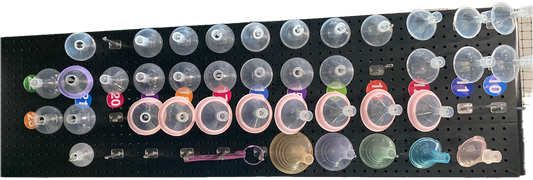
I squinted as the warm sun moved across the sky, captivated as I learned about the history of breast pump flanges and the single-handed devotion of one woman with questions--lots of questions--about why breast pumpers are being subjected to 24 mm flanges?
She told me that cows aren't being subjected to one size, yet lactating humans are. Cows have their pump flanges fitted to their teats because farmers know that the right size will allow the cow to become a cash cow making abundant milk. Now I was wondering along with Jeannette,
- What if using large and XL breast pump flanges is incorrect and actually harmful?
- What if this question is tested in a scientific study?
- What if the results are published in a medical journal?
- Who could plan, structure and run this study?
- Who would participate?
- Where would smaller flanges come from?
- What would happen if we used smaller flanges that fit, instead of bigger flanges?
The afternoon sped on, the sun went down.
And I was glued to my screen, afraid to leave even for a second because I wanted to learn every little detail.
The study came to life: 36 women using 13mm, 15mm, 17mm, 19mm flanges made by Maymom.
Benchmark #1: Pumping should feeling like "nothing" or "gentle tugging"
Benchmark #2: Milk sprays or streams out of the nipple pores
Benchmark #3: Pumping sessions are more productive and/or take less time
Benchmark #4: On removing the flange, the nipple is rounded and normal looking.
Benchmark #5: Nipples and breasts feel normal and comfortable between pumping.
I learned the history of breast pumps (they were invented by men.) And the first flange was also made by a man. And many of the flanges made after referred back to that first flange.
I learned how to size flanges for comfort and production, where to buy small flanges, how to sanitize them, how to store them and how to sell them. I engaged and my mind ran wild, putting practical details into motion.
I thought "After a flange fitting, my clients can order their flanges on Amazon." And, my stomach felt sick.
Continuing, I thought, "Or maybe, I purchase flanges wholesale, stock my ecommerce store and my minivan for instant gratification and supporting a small business." My heart sang. My stomach felt good.
I placed an initial order for small flanges to see the product.
I played with them. I thought through a flange fitting appointment and bought more flanges. I now owned a full set of flanges in 1 mm increments from 10mm to 19mm and a small inventory of 1 or 2 of each size. I loaded up my website and my car and started booking appointments.
Jumping into the deep end!
My first appointment was with a mother of three who had pumped full time for each of her babies from two months to over a year. Did I mention she was a NICU nurse as well?
Talk about jumping into the deep end! Boy...did I feel nervous. And when I feel nervous and out-educated, I take a deep breath and show up humble, ready to help, and admit, I am totally not an expert.
I measured the tip of her right nipple and started passing her flanges to try. It's like Goldilocks, some are too big, some are too small, and one or two feel just right.
Her milk sprayed... free of pain and constraints!
She loved how the 14 mm felt on her left nipple and how the 17 mm felt on her right nipple. For the first time in she-didn't-know-how-many pump sessions, she had ZERO pain. Her milk sprayed and spurted! Her nipples looked round and healthy after pumping. Her smile of joy said it all.
She couldn't believe it, so she decided to try her 24mm flanges again. She yelped in pain, "Ow...ow...ow!!! How did I put up with that??"
Indeed, how, and why do we put up with this?
Since February 2025, I have facilitated 150 flange fitting appointments. Every one of my clients felt more comfortable. Maybe not all of them experience true bliss, but enough do. Fitting breast pumping flanges has become my most heart-warming kind of appointment. I look forward to teaching pumping.
I am wowed by the relief on mom's faces. I feel their joy as they experience a perfectly comfortable 12 mm flange, instead of a clown-shoe-sized 24mm flange. Even when pumping bruised and bloody nipples, the pain of pumping is replaced by slight tenderness, hope and optimism.
I get to see almost everybody--not just seasoned pumpers--immediately experience gushing, streaming, shooting and spraying milk in a comfortable and personally satisfying way.
And for the record, I will still discourage you from feeding your freezer, when you have a baby to feed. Cuddle your little ones and keep them close. They are babies for only a quick minute.
The study, "Flange Size Matters: A Comparative Pilot Study of the Flange FITS Guide Versus Traditional Sizing Methods" was designed and authored by Lisa A. Anders, PhD, RN, IBCLC at University of North Carolina at Greensboro School of Nursing, Greensboro, NC and Jeanette Mesite Frem, MHS, IBCLC, RLC, CCE of Babies in Common, Northborough, MA. and Thomas P. McCoy, PhD, PStat. Clinical Professor Statistician, University of North Carolina at Greensboro School of Nursing, Greensboro, NC